Home Regional Workshop 25-28 September 2007 (Page 4)
POSTER SESSIONPresentation of 20 posters covering various themes of teak productivity, wood quality and farming and in a separate Poster Session promoted the scientific interactions of the Workshop.
The delegates also enjoyed one-day Field Excursion and cultural programme during the Workshop.
Concluding Session
The concluding session was chaired by Mr. Ramon Carrillo, Projects Manager, ITTO and co-chaired by Dr. R. Gnanaharan, Director, KFRI. The panel drafted the recommendations for discussion and finalisation among the august audience.
Recommendations of the Regional Workshop
Preamble
Teak excites more interest among the general public than any other tropical hardwood for its versatile wood with sterling properties. The rapid expansion of the teak plantations, however, poses a risk of undermining its reputation in global market place because of questionable promises in terms of growth rates and economic returns and wide variations in wood quality with the net effect of reducing the prices and therefore the financial viability of teak planting programmes. To avoid this, teak
growers, at the community and industrial levels, must ensure that the wood they produce is of the highest possible quality, which will mean choosing the right sites carefully, using good genetic stock, employing optimal rotation cycles and appropriate silvicultural, processing and marketing techniques.
Considerations
Knowledge of performance and behaviour of teak wood products of planted forests/clonal trees of shorter rotation including agroforestry and home garden forestry sectors is still inadequate in the context of sustainable tropical forest management (SFM). Appropriate steps need to be taken for refining and adopting up-to-date technology for application in realistic field conditions involving seed technology, tree genetics, silvicultural practices, agroforestry systems, protection, harvesting, processing, product development, value addition and marketing. These steps will help consolidate and strengthen the entire teak sector.
Recommendations
Policy & finance
1. Formulate appropriate (sub) policy on teak within the national forests, land use, industrial processing and socio-economic policies ensuring sustainability and the development of an enabling environment for the long term security of investments.
2. Establish and implement a comprehensive system of planning (involving long, medium and short term plans; and sites/locations, systems and market) for teak resource development.
Wood property analysis
3. Enhance the knowledge base of the wood properties and machineability of short rotation plantation teak - including those grown outside forests (ToF) - so as to ensure that they are processed within the acceptable tolerances of other tropical timbers.
Processing Technology
4. Develop new/innovative conceptual models for teak processing industries based on Best Available Technology (BAT) and the experiences from other industries.
Marketing
5. Develop common grading systems to support vibrant teak sector for the value-added processing of plantation teak wood. Develop market information system for collection, collation and dissemination of teak trading volume and price information
R & D and Training
6. Evaluate, document and disseminate R & D findings
7. Promote tree improvement through:
- Globally coordinated R& D
- Facilitating process of exchanging genetic materials.
8. Appraise the processing technology in use in the context of the new developments in research and transfer to the field.
9. Conduct comprehensive socio-economic studies of teak under different technological systems as a means to attract investment flows.
10. Undertake growth and yield studies by consolidating data from international network of sample plots.
Code of Best practices
11. Develop and promote sustainable practices for teak wood production and utilization codes ( social, environmental and economic)
International cooperation and coordination/networking
12. Strengthen regional and international cooperation, collaboration and co-ordination in teak development with special emphasis on human resource development.
13. Support KFRI, one of the lead institutions, to host the secretariat of Teaknet and establish linkages with other national, international and NGO networks in collaboration with FAO and ITTO.
14. Identify and analyse unsolved and emerging problems (both technical and non-technical) and initiate and implement measures to address them adequately in a coordinated and collaborative manner.
15. Prepare and submit the regional projects to international donor agencies in thrust areas, viz. processing and marketing, productivity/genetic improvement and social/ecological/policy issues.
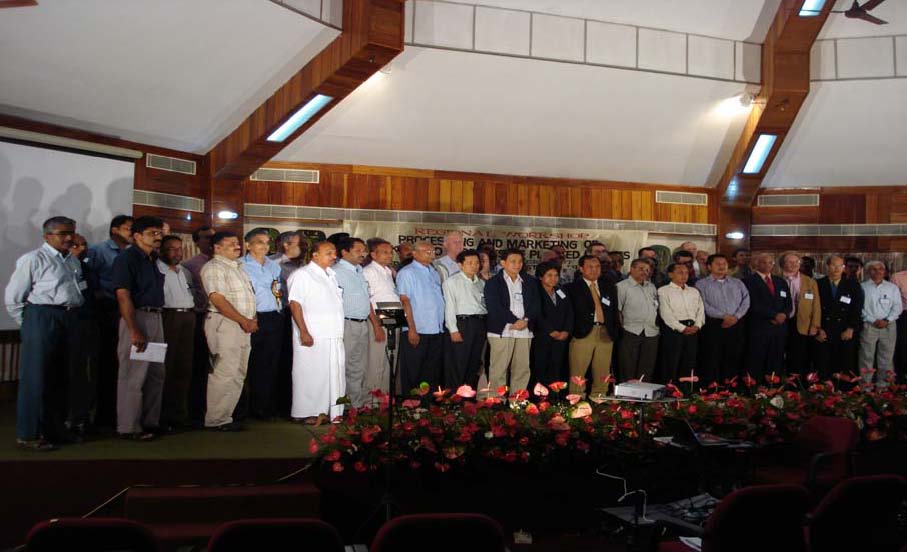
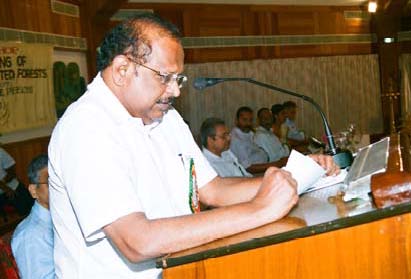
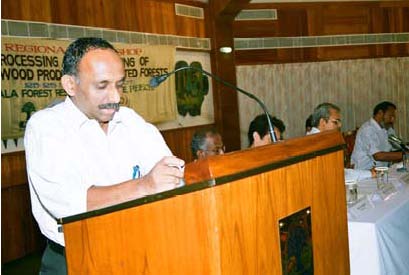
Welcome Address by Dr. E. P. Yesodharan, Executive Vice President, KSCSTE (Right)
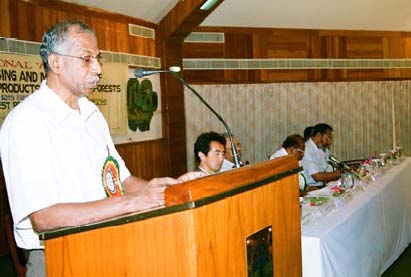
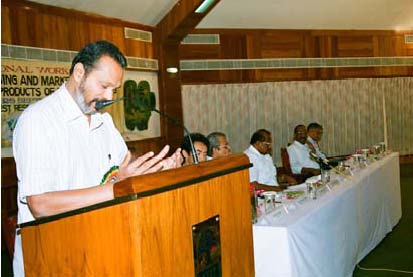
Mr. Rajaji Mathew Thomas, MLA delivering presidential address (Right)
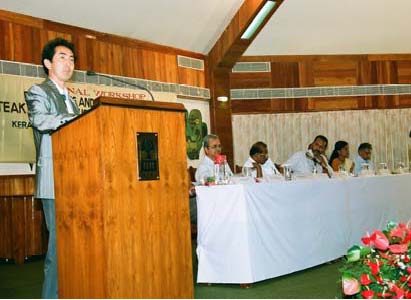
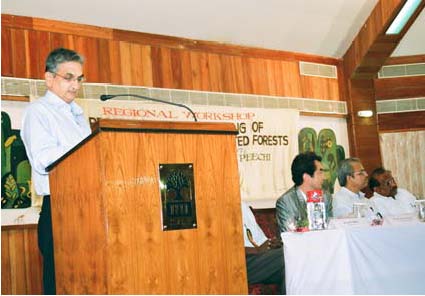
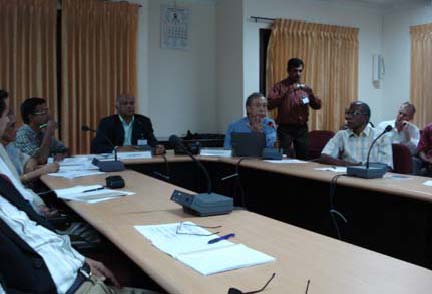
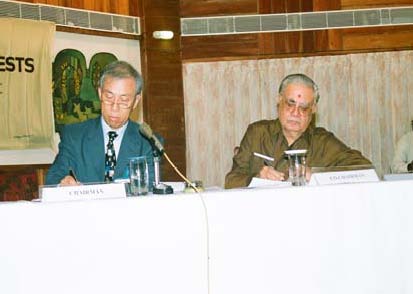
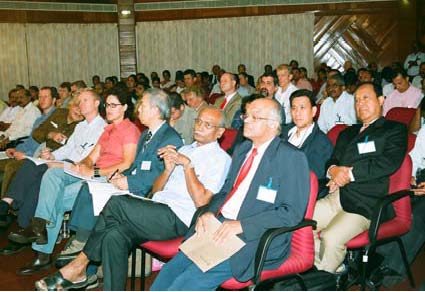
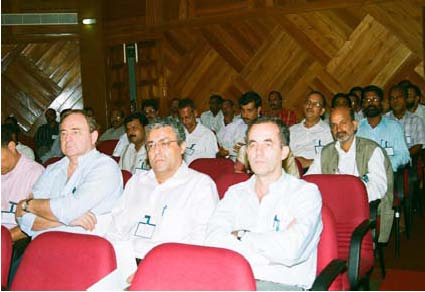
Glimpses of the Workshop


- Teak Workshop report-unedited.
- List of participants.
- Teak workshop sessions abstracts.
- Teakwood Production
- Assessment of Wood.
- Wood Quality
- Faster seasoning.
- Future Availability.
- Genetic Resources.
- Improvement of Teakwood
- Sustainability.
- Teak Farming.
- Teak Plantation.
- Quality Control
- Marketing Efficiency.